

A/B testing is an integral part of data-driven optimization teams. However, not every team has the same requirements and not every method is suitable for every organization.
While marketing teams often want to test visual changes quickly, development teams require deeper intervention in the backend.
How to implement tests technically is therefore a strategic decision in advance: client-side, server-side or hybrid?
In this article, we compare the three approaches, show their strengths and weaknesses and help you find out which setup is best for your team.
Client-side A/B testing
In the classic client-side A/B test, the HTML code is delivered identically to all users by the server. Only in the browser is a JavaScript snippet (e.g. from Optimizely, VWO or Varify) used to decide which variant a user sees. The DOM is then dynamically adapted.
Advantages:
- Fast setup without backend integration
- Ideal for UI and copy tests
- Enables fast prototyping and high test frequency
- No infrastructure changes necessary
Disadvantages:
- Possible flicker effect with non-recommended integration
- Server knows nothing about the variant
- Possible conflicts with the development team if there is no coordination on ongoing tests
Who is this approach suitable for?
- Marketing and UX teams that want to validate ideas quickly
- Companies that work in an agile way and want to carry out many tests with a short lead time
- Teams without direct access to the backend
Server-side A/B testing
In server-side A/B testing, the assignment to the variant is made on the server. The HTML code delivered differs depending on the variant when the page is first loaded.Advantages:
- No flicker effect
- Complete control over all parts of the page (including logic, data, layout)
- Ideal for in-depth tests, e.g. with backend or API changes
Disadvantages:
- More complex technical implementation
- High need for coordination between teams
- Usually requires feature flags or own infrastructure
Who is this approach suitable for?
- Tech-savvy company with a strong dev resource
- Teams that also want to test pricing, API or backend logic
Hybrid A/B testing: the best of both worlds?
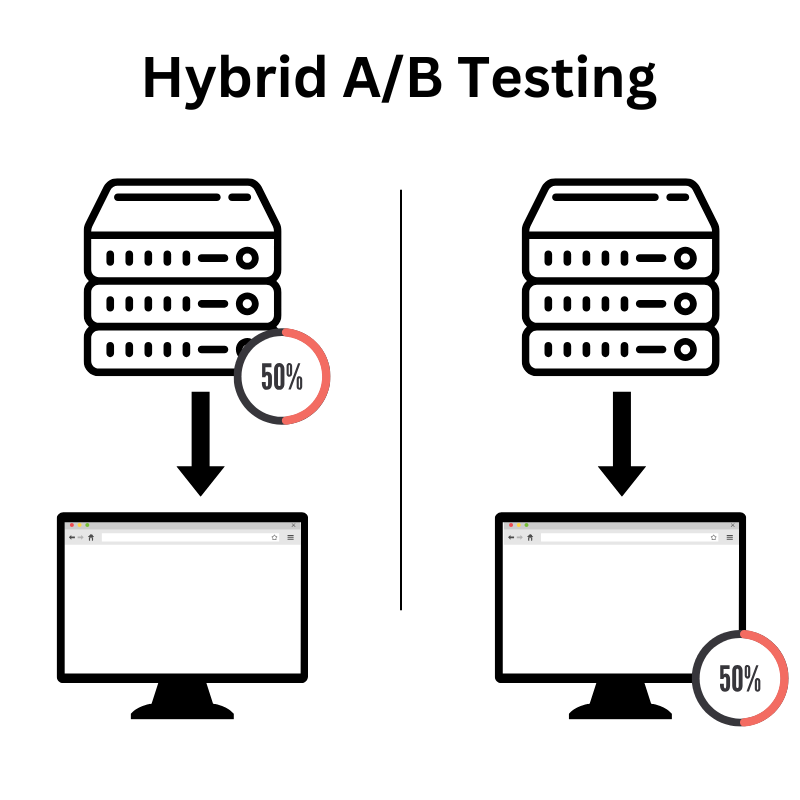
In the hybrid approach, the variant is assigned on the client side, but the decision is saved in the cookie or LocalStorage. This allows the server to "see" the variant on the next request and react accordingly. For example, with customized HTML or API responses.
Advantages:
- No complete server integration necessary
- Server can still react to specific variants
- No flicker effect, as the variant is already known before rendering
Disadvantages:
- No server-side difference possible on the first visit
- Additional complexity in communication between client and server
Who is this approach suitable for?
- Teams that start on the client side but want to use server-side advantages
- Companies with existing client testing logic that want to expand
Comparison of the approaches at a glance
| Criterion | On the client side | Server side | Hybrid |
|---|---|---|---|
| Technical effort | Low | High | Medium |
| Flicker effect | Possible (with poor integration) | No | No |
| Backend control | None | Complete | Partially |
| SEO influence | Restricted | Direct | Restricted |
| Setup duration | Very fast | Slowly | Medium |
| Flexibility | High | High | High |
| Who is it suitable for? | Marketing, UX, agile teams | Dev teams, backend tests | Teams with a client-side base that want to scale |
Conclusion & recommendations for action
Client-side, server-side or hybrid? The choice depends on your resources, goals and technical capabilities:
- On the client side, it is ideal for fast, visual tests, rapid prototyping and high flexibility.
- Server-side offers maximum control and is suitable for more complex, in-depth tests.
- Hybrid approaches bridge the gap: They combine the ease of client-side testing with server-side awareness - ideal for scaling teams.
💡 If you want to scale in the long term, you should look into hybrid setups and the connection of APIs or cookies. They offer a lot of flexibility without the hurdles of a fully server-side system. Because one thing is clear: good tests not only need ideas, but also the right technical foundation.